
Coding for Kids Explained: How It Applies to School and Everyday Life
One of the most common questions parents ask is: “How does what my child is learning actually translate to real-world use?”
It’s a fair question. While coding lessons may seem screen-based, the thinking skills behind them show up very clearly in your child’s everyday learning, especially in school. Here’s how this looks across different age groups, with real, relatable examples.
Ages 7–9: Strengthening Logical Thinking for Everyday Tasks
At this stage, coding helps students develop step-by-step thinking.
For example, when solving a math problem like: “If you have 3 groups of 4 apples, how many apples are there?”
A child needs to understand sequencing and grouping. In coding classes, they practise this by building simple programs where actions must happen in order — like moving a character step-by-step or repeating actions using loops.

This reinforces the idea of breaking problems into smaller parts. So instead of guessing, they learn to think: What do I do first? What comes next? This directly improves how they approach math questions, instructions, and even daily routines.
Ages 10–12: Applying Problem-Solving to School Work
At this stage, students move from understanding to applying logic more independently.
Take a more complex math problem: “A shop gives a 10% discount on a $50 item. What is the final price?”
Students need to plan the steps — calculate the discount, then subtract it. In coding, they practise similar thinking when building projects like calculators or quizzes. They must decide what inputs are needed, what steps the program should follow, and what output it should give.
If something doesn’t work, they debug — finding and fixing mistakes. This mirrors how they check their math workings or refine answers in school. Coding trains them to approach problems methodically instead of rushing to answers.

Ages 13–17: Tackling Real-World Problems and Projects
For older students, the application becomes even more practical and visible.
For example, in subjects like math or science, students may need to analyse data or identify patterns. In coding classes, they might build a simple program or project that organises data, calculates results, or presents findings clearly.
Imagine a student creating a basic budgeting tool or analysing survey results for a school project. They are applying logic, structuring information, and thinking about usability — all these skills are developed through coding.
At this stage, it’s not just about getting the right answer, but understanding how to approach complex problems, organise information, and present solutions effectively.
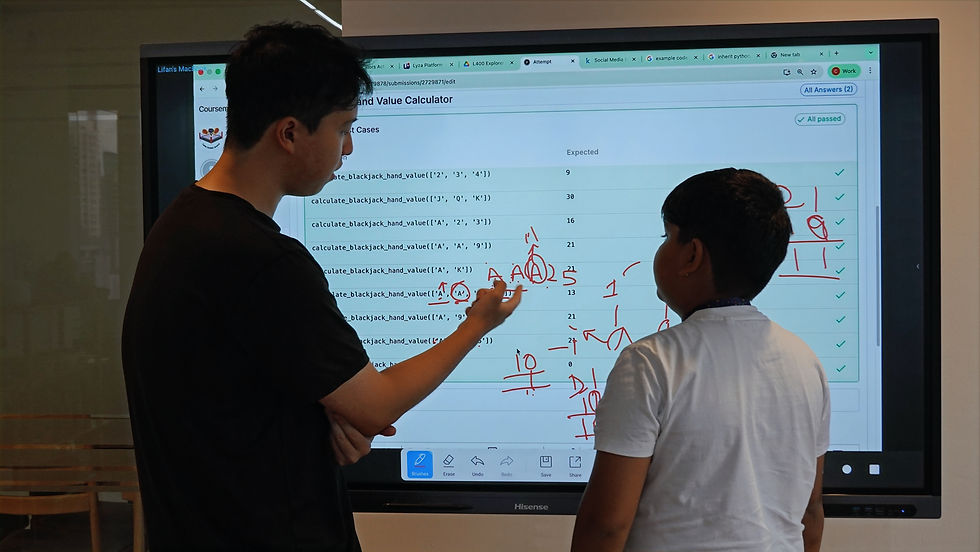
A Skillset for Everyday Learning
What ties all of this together is not just coding itself, but the way it trains students to think. They learn to:
Break problems into manageable steps
Test and refine their ideas
Approach challenges with structure and clarity
These are the same skills used in solving math problems, writing compositions, and handling school projects.
Learning That Makes a Difference Now
At LYZA Education, coding is not taught in isolation, it’s taught as a way of thinking.
Whether your child is learning how to structure a simple program or build a more advanced project, they are developing skills that directly support how they learn in school today. Real application isn’t something far in the future, it’s already happening every time your child approaches a problem with clarity, confidence, and logic.
Sign your child up for our coding classes today!


Comments