
Singapore’s AI Agent Registry: How we work with AI as kids and adults
At Lyza Education, we stay on top of the latest tech trends. As Singapore solidifies its role as a global innovation hub, even the public sector is embracing cutting-edge artificial intelligence. In June, a major announcement revealed that over 100,000 public officers will soon use AI agents in their daily work, backed by a secure government registry.
While this news focuses on public sector transformation, its ripple effects are far-reaching. For students, parents, educators, and professionals, it signals a clear shift: AI literacy, AI governance, and agentic AI skills are no longer optional, they are essential.
What Is Singapore’s AI Agent Registry?
According to GovTech Chief Executive Goh Wei Boon, Singapore is building a registry to track the ownership, activities, and usage of AI agents deployed by public officers. The goal is to harness powerful AI tools without compromising security, compliance, or public trust.
Unlike basic chatbots, AI agents can act autonomously, planning workflows, executing tasks, interacting with software, and making decisions with minimal human input. This opens huge productivity gains, but also creates new challenges around governance and safety.
The registry is part of GovTech’s upcoming AI Assistant Desk platform, a secure suite of AI tools designed as a digital assistant for government employees.
Breaking Down the Technical Terms (For Parents and Learners)
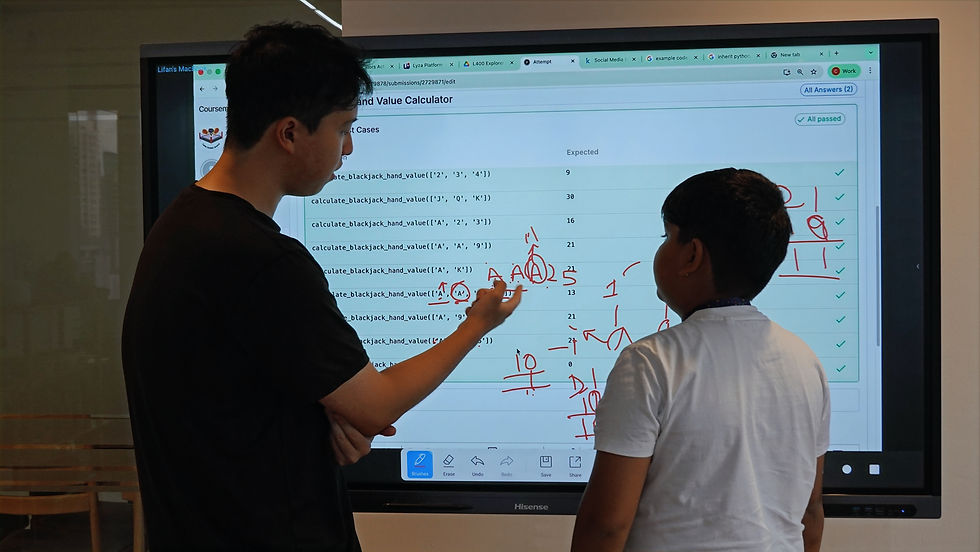
It is normal to hear these terms and feel unsure. That is why we have gotten Colin, our coding educator that graduated from UCL with a Bachelors in Computer Science to explain these terms in plain language.
What are AI Agents?
An AI agent does not just answer questions. It can plan and do tasks, like drafting a report or checking steps across different systems. Singapore’s registry helps the government track which agents exist, who owns them, and what they’re allowed to do.
At Lyza Education, we teach students what AI agents can do, planning and executing tasks. However, during learning, we use a customised AI tutor on our platform instead of a full agent. Our tutor can review a student’s code and offer hints, but it never completes assignments for them. Children still do the thinking and coding themselves. That’s how they learn with AI, not replace learning with AI.

Did you know? |
At Lyza Education, we also use AI a lot. It has definitely helped us in solving minor bugs on our code in our in-house platform and understanding parents' needs. |
What are Digital Assistants?
Digital assistants provide everyday help with writing, explaining, brainstorming, or organising work. Many Singapore public officers already use Pair, the government’s AI chatbot. The upcoming AI Assistant Desk is the next step: a secure personal assistant with built-in rules.

At Lyza, students also create their own assistants with a clear purpose and instructions. This teaches them to use AI as a tool, not a shortcut around thinking.
Did you know? |
In L216 GPT Explorers with Kebbi, our students also learn about AI Assistants, where they can customise how Kebbi would behave and react based on their project's needs. There is even a knowledge base for Kebbi to pick up the correct and valid information to reply to users based on the knowledge. |
What are Third-party AI Tools?
These are AI apps made by other companies, such as ChatGPT, homework helpers, image generators, and more. They are not directly affiliated with schools, companies, or the government. While useful, they require caution: never share private information (NRIC, addresses, school details), double-check answers, and avoid fake or unsafe apps.
At Lyza, we integrate AI into our Lyza Platform so students get safe, supervised access. We teach prompt engineering, how to talk to AI properly, while teachers guide students in class and parents track progress on our platform.
Why This Matters for Your Child’s Future
Singapore’s move to register and govern AI agents sends a strong message. The future workforce, including your child, will need to:
Understand AI agents (not just chatbots)
Use digital assistants responsibly
Navigate third-party AI tools safely
Learn AI governance principles early
At Lyza Education, we do not just follow these trends, we build them into our curriculum. From our AI tutor on the Lyza Platform to project-based learning with tools like Kebbi, we ensure students are future-ready, not just test-ready.
Ready to Give Your Child an AI-Literate Future?
As Singapore leads the way in secure, agentic AI, the best time to build AI skills is now. At Lyza Education, we combine cutting-edge technology with pedagogical best practices, so your child learns with AI, not just about it.


Comments